Brian’s tall frame slunk into the partner’s office. The door closed behind him. This was odd because our tax partner, Elliot Jamison, had left for lunch ten minutes ago. Brian always seemed to carry the look of someone up to no good—large expressive eyes, dreadlocks, and a half-smile. Really more of a smirk than a smile. Less than five minutes later, Brian slipped into the small office we shared and shut the door. Continue reading →
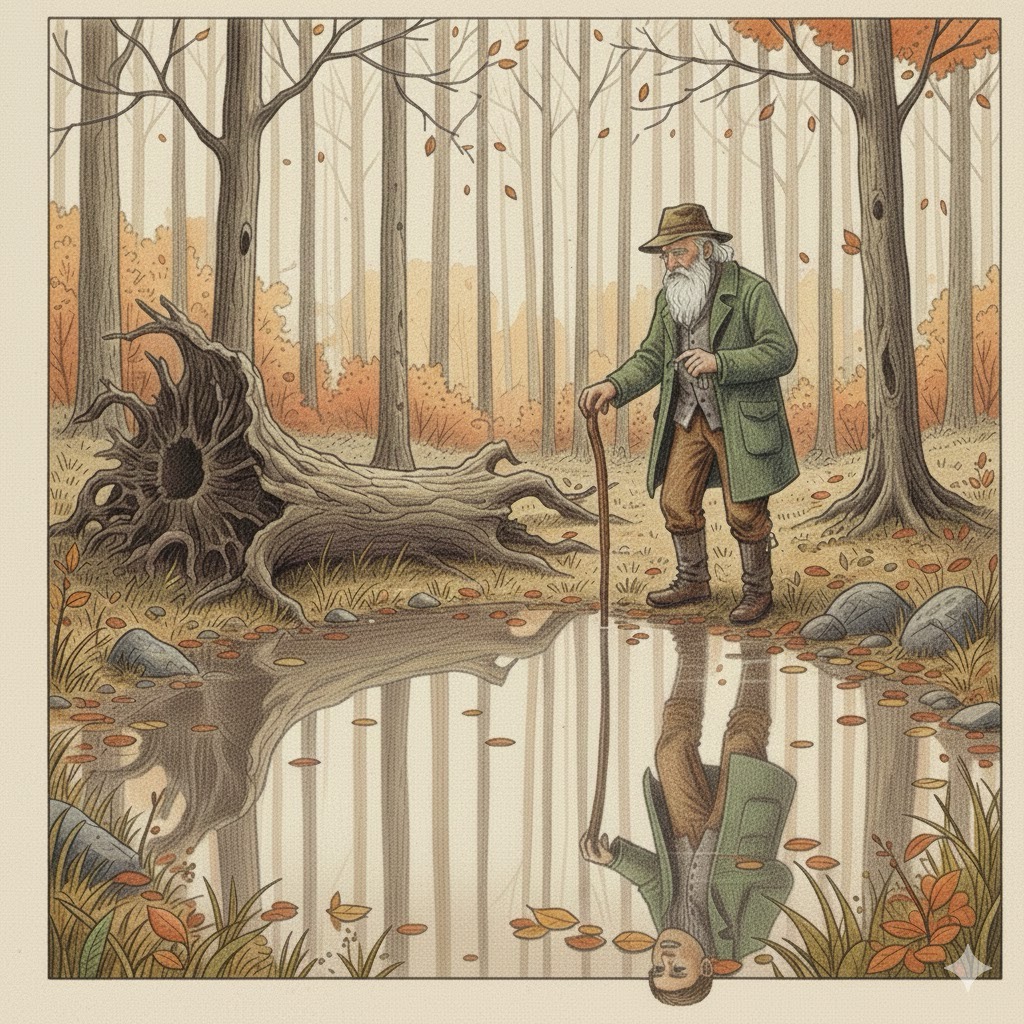
I shuffle forward along the forest floor,
impeded by the infirmities of an Old Man.
I rest by a crystal-clear-blue stream,
lost in the futile dreams of a Young Man.
Filling my canteen to the brim, I
drink my fill—water clear and bright.
Standing to resume my walk,
my footsteps are sure and light.
A wind-fallen tree blocks my way,
Old Man’s voice cautions, “go around,
don’t risk harm in those tangled limbs,”
Young Man’s voice asserts, “hold your ground.”
I face the obstacle in my path,
weigh the two voices in my head.
Pick my way around the impasse,
or jump—end up impaled or dead?
I reflect on the wisdom of my years—
marvel at the Young Man’s absence of fear.
It’s early December as I rake the last of fall’s leaves. Red, purple, yellow— intoxicating after first frost, now dull, dreary, and dirty. Piled in the bed of my truck, we drive to the dump, racing the season’s first snowfall.
Time to pull down the snow shovel. Studies have shown men over sixty-five ought to avoid shoveling snow. I visit the gym three days each week only to stay in Olympic shoveling shape.
So far so good, lots of snow falls in Colorado, and here I am in my seventies, shovel in hand. With Parkinson’s, snow is not all that falls. Red, purple, yellow—painful bruises.
Some days are easy, four inches of feather-light powder brushed off with a push broom. Other days, the drifts are so tall, even the snow- blower surrenders all hope. Then my trusty shovel steps up.
A while ago, a friend of mine died at his office desk working on a corporate budget in the early morning hours. I can think of nothing worse.
Well, dying on the driveway shoveling snow, that may be worse.
The mid-90s were the Wild West days of the telecom industry. Most American families had adopted cell phones. Many dropped their landlines. At the same time, home internet became ubiquitous. Landline phone companies began a transformation to wireless and internet services. Much of this innovation was spurred by the Telecommunications Act of 1996. Companies rushed to merge and implement revised strategies to survive.
Organized crime found pearls of opportunity in the new era. In 1996, a Fortune 500 company sold a small landline telephone company tucked away in rural Cass County, Missouri. Ostensibly, the buyer was a highly regarded business executive. In what could be a scene plucked from The Sopranos, the executive acted as a frontman for the New York Mafia. The Mafia allegedly owned the holding company that acquired the phone company. They used the same frontman to purchase a bank in nearby Garden City.
After acquiring the phone company and bank, the executive and his Mafia associates allegedly used the companies and other Mafia-owned businesses to perpetrate fraudulent internet porn billing schemes on the American public. These actions cost consumers as much as one billion dollars. At that time, it was the largest consumer fraud in history.
The Mafia’s Telephone Company is inspired by that true story. The people and companies described in this novel are fictional. The crimes are realistic portrayals of fraudulent schemes carried out across the United States.
I worked with the frontman during the early ’90s, before his involvement with the Mafia. I returned to Missouri in 2005 as a consultant, assisting the group tasked with removing the telephone company from the Mafia-controlled holding company.
I’ll hold your hand in mine to protect your heart If you slip away, you’ll drift free like a child’s balloon, and when you fall to the ground, your heart will be broken
and will shatter into a million pieces Healed by time, your mended heart will grow back with scars and cracks
The scars suppress memories of your pain, cracks let hope seep in until your heart once again fills with love
I’ll hold your hand in mine to protect your heart If you slip away, you’ll drift free like a child’s balloon, and I will spend a thousand years searching to find you again


 North Idaho Stories